Sunday, April 22, 2012

Relay for Life 2012


After speaking here at Relay for the last few years, I always get people who ask me why I do it. They say, “Ashwani, aren’t you tired of hearing your own voice?” And I always give them the same response: “Of course, I am, but with a voice like an angle people just want to hear me speak.”

But on a serious note, the reason I continue to stay active and make my voice heard is because of something my parents taught me a long time ago.“If it doesn’t kill you, don’t act like it does.”

We’ve all been through an experience that has changed our lives. Everyone here, whether you experienced it directly, or know someone who did, has some moment that changes the way you perceive the world.

For some, it could be an event, like when you got accepted into college, or the time you arrived at a new place. For others, it could be getting your first job, going on your first date, finishing an entire burrito at Chipotle, or meeting your best friend. It could also be the moment you realized that you actually have no friends (you know who you are). It may be even be the day you heard a motivational speaker at a Relay for Life event; whose good looks, witty jokes, and captivating charm made you want to empty out your wallets and tip him for a job well done…..(thought I’d give it a try).

But for me, what changed my life was an experience I had as a child.

"For a long time it gave me nightmares, witnessing an injustice like that... It was a constant reminder of just how unfair this world can be... To this day, I can still hear them taunting him... "Silly rabbit, Trix are for kids!"... I mean, why couldn’t they just give him just cereal?!”

But for those of you who never watch the Fresh Prince of Bel-Aire – you know, the episode they go camping and they get lost in the woods, they’re in the cave for the night and Carlton is talking…ah, never mind. Anyway, for those of you who never watch the Fresh Prince of Bel-Aire, let me tell about another experience that changed my life.

I was 13 and in the middle of the 8th grade. Like most boys, I thought I was the invincible! I teased my younger sister, gave my parents a hard time, and ran around the house with my underwear on my head thinking I was superman. Who doesn’t? But that all changed when I was diagnosed with Non-Hodgkin’s Lymphoma: Cancer.

Now, for a 13 year old kid, cancer didn’t really have any meaning. Sure, I heard about it before, but it was something only old people got. I knew that cancer patients were bald, looked very sick, and were always in the hospital. I also knew that after some time, I never saw some those people ever again.

But, you see, what really rattled me during my diagnosis was seeing my parents cry for the first time. It was having my parents look at me like I was about to die. It was seeing all our friends and family come in and out of house, bringing baskets of gifts and boxes of tissues. It was not being able to attend my last year of middle school, or hang out with any of my friends. It was spending every day on X-ray machines and hospital beds. It was about seeing kids younger than me go through more pain and agony that I had to. It was having numerous, painful surgeries that seemed to have no end in sight. It was all the bandages and scars. It was that my life got turned completely upside down.

That’s what cancer was for me. And today, I can’t go more than a few seconds after just hearing the word cancer without getting a little emotional. I start to remember all the things that I went through and that I saw other patients go through. I start to remember the pain.

So why then, am I here today, and every year, speaking out and sharing my experience?

It’s because I learned that if it doesn’t kill you, don’t act like it does.

But I think Kanye West said it best, quote “n-n-now th-that that that don’t kill me, can only make me stronger.” And that guy always knows what he’s talking about.

In the same way, I believe that my experiences have made ME stronger, and have allowed me to share my story with others. So if my experiences can help those who are going through the same thing right now to realize that they are not alone; or if it helps people understand the difficulties that cancer patients and their families undergo; or if I can somehow inspire just one person to help end this disease, then I feel it is my responsibility to speak out.

And that’s what events like Relay for Life are all about. It’s about helping us understand that if we fight together, we can survive together.

Because life is truly precious, and every day is a gift. And even if we face a challenge, we can still be optimistic. Because as Martin Luther King Jr. once said, “its only in the darkness that you begin to see the stars.”

Well I’ve been looking, and I’ve been seeing shooting stars everywhere.

Thanks so much!

Monday, April 2, 2012

Hands off my health care!

President Obama’s Affordable Care Act ensures that government does just that—lay its hands off your medical care. Here’s how:

The Affordable Care Act (i.e. “Obamacare”) helps doctors avoid having insurance companies dictate how they should treat their patients (via high overhead costs, billing limitations, and bureaucracy) ; it helps the insurance companies by adding millions to their payroll; it helps the economy by reducing the deficit; and it helps the average taxpayer by reducing their taxes.

But most importantly, the law is designed to help patients. Healthcare is supposed to be about the sick. It’s not about the doctors, the nurses, the insurance companies, the interest groups, or the politicians. It is ultimately about providing the necessary medical assistance to those who need it and are suffering.

The problem, however, is that the United States is the only industrial nation in the world that does not provide equal access to healthcare to its citizens. Despite this, the American people still pay more for their limited healthcare than their counterparts in other countries.

The Affordable Care Act, therefore, provides a fix to this problem by cutting costs and expanding coverage. But these goals are harder to achieve without an individual mandate, the issue now facing our Supreme Court.

Everyone needs healthcare. But without an individual mandate, costs will increase for all of us when those who decided to “free-ride”, and not buy health insurance, face an unexpected illness which forces them to get more expensive care from the hospital ERs. When this occurs, and these people can’t afford that care, their treatment costs are absorbed by hospitals. The hospitals, in turn, raise the cost of their services on the insured. Furthermore, insurance companies raise their premiums on policyholders.

Prior to Obamacare, this has been the situation, and has cost the average taxpayer an additional $1000 per year in taxes. Thus, those of us who have played by the rules have been forced to give free emergency care to those uninsured. This, in essence, has been the true “individual mandate.”

In the 1990s, Republicans proposed the individual mandate as a counter-part to President Bill Clinton’s universal health-care bill. It was their idea in the first place. But now that Obama has put his stamp on it, they must oppose it. But if the individual mandate is overturned by the Supreme Court, it will only increase the need for a single-payer system.

Under Obama’s law, healthcare is NOT a government-run program. There is no single-payer system, and private-insurance companies still run the market. What Obamacare did was stay true to the capitalistic principals of the free market and break-up the monopolies that health insurance companies held. Specifically, he made sure that these companies would not deny coverage based on preexisting conditions, gave people the flexibility of changing their insurance companies, and provided the uninsured with affordable care.

If opponents of Obamacare successfully repeal the law, the nation’s uninsured would rise again. And with an individual mandate that is now “unconstitutional”, we must follow the lead of nations such as Great Britain, France, Germany, and Canada that provide universal healthcare for their citizens.

So we can either start trying to fix the many other problems our nation is facing, or we can continue to debate about whether or not a cancer patient should receive affordable healthcare. Either way, the government will need to play a role in how our healthcare system works. The question, then, is how large of a role they play.

Saturday, March 10, 2012

A True Fiscal Conservative

I often hear people say, “I am socially a Democrat but I’m fiscally a Republican.” To me, however, this sounds highly contradictory.

To be a Democrat is to be socially liberal and fiscally conservative. After all, government’s job is not to control people’s lives, but help people control their own lives. In all my blog posts, I have tried give meaning to this concept. But now it is time to take a look at the six main pillars of the “fiscally conservative” handbook to reverse the notion that “government is not a solution to our problem, government is the problem”.

1. JOBS

When companies like GM and Chrysler were on the verge of bankruptcy, there were no private companies or investors willing to assist these companies. It was only then that the need of government intervention arose. By saving the American auto-industry, the President saved millions of American jobs and created an environment where we can continue to compete globally.

2. FREE MARKET

Let us not forget that businesses -- not government agencies-- are the true engine of job creation. But when they stop hiring or are deregulated to a point that unfairness occurs, we need the government to enact policies that allow the free market to occur. This, in turn, actually strengthens capitalism by providing predictability, stability, and fair competition to the market (which is why we illegalize monopolies) and prevents fraud that hurts companies who play by the rules.

As the President mentioned in his State of the Union, “We can either settle for a country where a shrinking number of people do really well, while a growing number of Americans barely get by. Or we can restore an economy where everyone gets a fair shot, everyone does their fair share, and everyone plays by the same set of rules.”

This is why the President passed Wall Street reform to end "too big to fail" bailouts and keep government out of the private-sector. This will also protect consumers, reward managers who play by the rules, and prevent another financial crisis.

3. SMALLER FEDERAL GOVERNMENT

The Emergency Jobs bill provided billions of dollars in needed assistance to help states avoid a budget crunch that would force them to lay off teachers, firefighters, police and other public workers. Thus, it helps strengthen states to make decisions on their own.

The Affordable Care Act also left power to the states by reforming the private health-insurance market to avoid a government-run program and helping these states pay Medicaid payments to doctors. Further, by adding 30million new patients for doctors and customers for insurance companies, costs for states are reduced.

4. INDIVUAL LIBERTY

Keeping the Federal government out of marriage and abortion protects an individual’s freedom to marry who they love and a woman’s right to choose what to do with her body.

5. TAX CUTS

President Obama has passed the largest tax cuts in history with his first stimulus package. The previous record was held by President Bush’s “Jobs and Growth Tax Relief Reconciliation Act of 2003” which amounted to about $230 billion in tax cuts. President Obama’s “American Recovery and Reinvestment Act of 2009”, on the other hand, amounted to about $280 billion in tax cuts. The difference was that the Bush tax cuts were targeted at the wealthiest Americans, whereas the Obama tax cuts were targeted at the middle-class and small businesses.

As President Obama explained in his State of the Union, “Democrats don't begrudge financial success in this country. We admire it. When Americans talk about folks like me paying my fair share of taxes, it's not because they envy the rich. It's because they understand that when I get tax breaks I don't need and the country can't afford, it either adds to the deficit, or somebody else has to make up the difference - like a senior on a fixed income; or a student trying to get through school; or a family trying to make ends meet.”

Given this choice, President Obama also helped lower taxes for millions of Americans by making healthcare cheaper and more affordable, helping students pay off their college loans, reforming the credit card industry, providing tax incentives to small businesses, extending the payroll tax cuts and unemployment benefits, raising the debt ceiling, and ending the Iraq War.

All these not only cut costs, but also help save billions of dollars while putting more money into people’s pockets. This, in turn, allows them the flexibility to divert their attention from finding access to basic necessities to finding a job.

6. BUSINESSES

According to the Bureau of Labor Statistics, only a small percentage of employers have reported regulation as a reason for laying off workers. Instead, the data shows that the main issues were tied to insufficient demand. Specifically, if no one can afford to buy what a business has to sell, the business will soon fail and jobs will be lost. In this sense, an ordinary middle-class consumer is more of a “job creator” than the average CEO.

This is where we need government. Not to “socialize” every aspect of our society, but simply to help increase consumer demand and provide added assistance to the private sector. The best way to create demand, therefore, is by providing tax breaks for the middle-class. It is by keeping benefits, like Social Security, Medicare, and unemployment benefits that millions of Americans are dependent on. It is by educating our citizens to ensure they are able to compete with the rest of the world.

But I still wonder how someone can be a Democrat without being fiscally conservative?

Monday, December 26, 2011

A Cure for Cancer?

As we end 2011 with a bipartisan agreement to have a temporarily two-month extension of unemployment insurance and payroll tax cuts, we must understand the need to continue these benefits through all of 2012.

Specifically, this two-month package preserves a $1,000 payroll tax cut for the middle class, and extends unemployment benefits for the long-term laid off. As President Obama described it, “This is for 160 million people who are going to see their taxes go up if Congress doesn’t act. This is for 5 million individuals who are out there looking for a job and can't find a job right now in a tough economy who could end up not being able to pay their bills or keep their house if Congress doesn’t act.”

House Republicans, many of whom have said previously that they did not want an extension at all, recently changed course and said they would accept a one-year deal or nothing at all. Although this has been the goal of President Obama and Democrats all along, the Republican leadership tried to tie the extension to other very partisan legislative measures—thus making it harder to pass.

Bipartisanship requires a willing partner. But with a Republican party that has previously rejected all efforts by Obama to spur economic growth, a party that has said their single most important goal is to defeat Obama in 2012, and a party that has risked two government shut-downs, this two month extension was the only viable way to prevent a tax hike for the middle class at the end of this year.

Proof of the difficulty Obama has had to pass such job-creating measures is the opposition faced during the first stimulus package, the bailout of the American auto-industry, Wall-Street reform, Health-Insurance reform, Student-Loan reform, and the American Jobs Act. Each of these measures have proven to help the economy, provide needed tax cuts for small businesses and middle-class families, and create American jobs.

In the past, however, Republicans have argued that we should not invest in immediate job-creating infrastructure projects, let the American auto-industry to go bankrupt, continue deregulating Wall Street, allow the health insurance industry to continue raising premiums while reducing care, provide fewer incentives for students to attend college, and issue tax cuts for the rich instead of tax cuts for the middle-class.

Democrats are not arguing for free healthcare, but affordable healthcare; they don’t want free handouts, but job opportunities; they don’t want to punish the rich, but ensure they pay their fair share. It’s not about social welfare or doing something humane. This is purely economic, and is about creating an environment where everyone has an equal opportunity to succeed. In fact, the main reason why all the successful businessmen, lawyers, doctors, scientists, etc. are at the level of success that they have achieved is because at some point, someone invested in them: in their education, in their community, in their well-being.

Republicans say they want government out of their personal lives, unless it comes to issues regarding gay marriage or abortion. Although this seems hypocritical, it does bring up an important point: in a society that has become more culturally, politically, and economically interdependent, we are all connected. As such, every aspect of our economy is connected—healthcare, unemployment, education, public sector and private sector.

This sense of collective identity was expressed in the Pulitzer Prize winning book, The Emperor of all Maladies, by Siddhartha Mukherjee. Through this biography of cancer, Mukherjee highlights the significance of people from different fields working together to better understand and treat cancer.

Borrowing and extending from the work of a botanist and an animal physiologist in the late 1830s, Rudolf Virchow was able to develop a “cellular theory” of human biology to better understand diseases, like cancer, in terms of cell growth. In the early 1900s, Paul Ehrlich used chemical dyes from the flourishing German clothing industry to selectively stain tissues for histological examination, helping him develop an idea to target disease-causing organisms and create a template for chemotherapy. In the 1940s, scientists discovered that the mustard gas used as a chemical warfare agent during WW2 could also serve as an effective treatment for cancer. After the war, Sidney Farber (the father of modern chemotherapy) used his experience as a pathologist to work with Mary Lasker in applying modern political lobbying efforts to build public support for cancer research.

It was through the understanding of this shared responsibility that millions of Americans, including me, have benefited from advancements in cancer treatment.

Therefore, by continuing to work together, realizing how interdependent we are of one another, and understanding the obligations we have toward each other, not only can we continue growing this economy, but we can eventually find a cure for cancer.

Wednesday, November 16, 2011

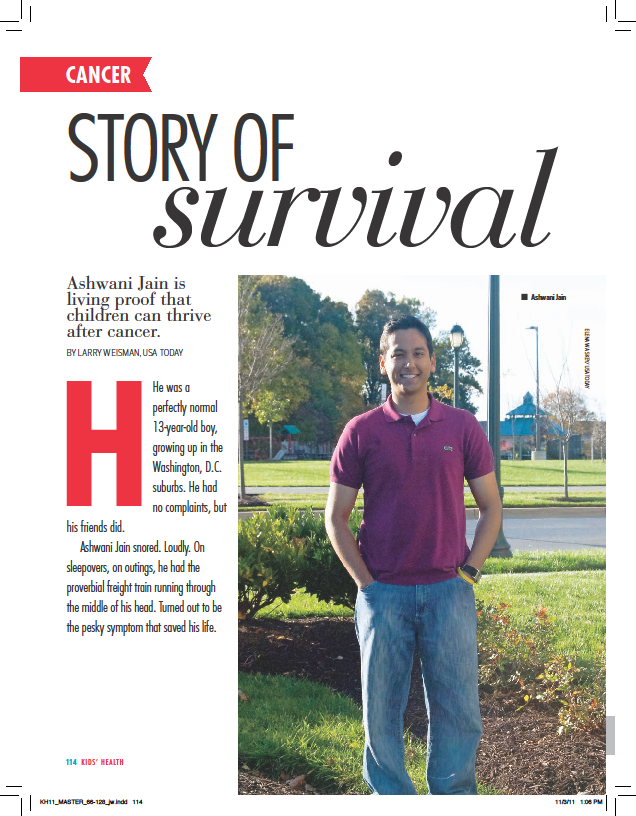
USA TODAY Article On Me

I was interviewed by USA Today for their upcoming Children's Health Magazine. It should be out on newsstands on December 6th. Here is the article. Hope it can be inspirational and helpful. Enjoy!

Cover Page


PAGE ONE of my segment:


PAGE TWO of my segment:

Wednesday, November 9, 2011

We The People

Last week, the Labor Department reported that the unemployment rate dropped to 9 percent. Although this number is still very high, independent economists argue that if government spending cuts are put into effect too quickly, they could be a severe drag on economic growth and could potentially derail our fragile recovery.

A major reason the unemployment is still high is because businesses are not hiring. People want jobs and are looking. But American businesses have argued that without an increase in demand for their products, there's no incentive for them to create more jobs.

This is where we need government. Not to “socialize” every aspect of our society, but simply to help increase consumer demand and provide added assistance to the private sector. As a business major, I understand the need to cut costs and increase revenue. After all, profit is the bottom line. But in order to earn the most profits, you have to make the right investments.

By not investing in the American people—through payroll tax cuts, unemployment benefits, and social welfare programs like Healthcare—or providing tax incentives for small businesses, or spending on infrastructure and clean energy, we are not promoting long-term growth and stability. Just as a business would not layoff all its employees and sell all its cash-generating assets—even if it meant greater short-term profits—we cannot allow gutting programs that help the American working class.

Yes, as conservatives say, we need to emphasize personal responsibility. But when you have a system that favors the rich through corporate tax loopholes and “too big to fail” companies that hold the economy hostage, government is needed.

The problem is not that the rich are getting richer. Democrats are not arguing for equality of outcomes. The problem is, instead, that the rest of America is getting poorer. A recent report from the Congressional Budget Office found that, “over the past three decades, the distribution of income in the United States has become increasingly dispersed -- in particular, the share of income accruing to high-income households has increased, whereas the share accruing to other households has declined."

It seems as though the “pursuit of happiness” written about in our Declaration of Independence has been more difficult to attain. The idea that everyone should have an equality of opportunity has weakened. But as our Constitution emphasizes, government’s job is not to control people’s lives, but help people control their own lives:

“We the People of the United States, in Order to form a more perfect Union…promote the general Welfare and secure the Blessings of Liberty to ourselves and our Posterity.”

Saturday, November 5, 2011

4 More Years!


Three years ago today, Barack Obama was elected President of the United States.

This is why I supported him back then, and why I will continue to support him for another 4 more years!

http://www.youtube.com/watch?feature=player_embedded&v=-MwyErsB6Oo

With over one million Americans donors and a never before seen grassroots campaign not funded by corporate lobbyists, find out how YOU can help change this nation. Email me at ajain@ofamd.org